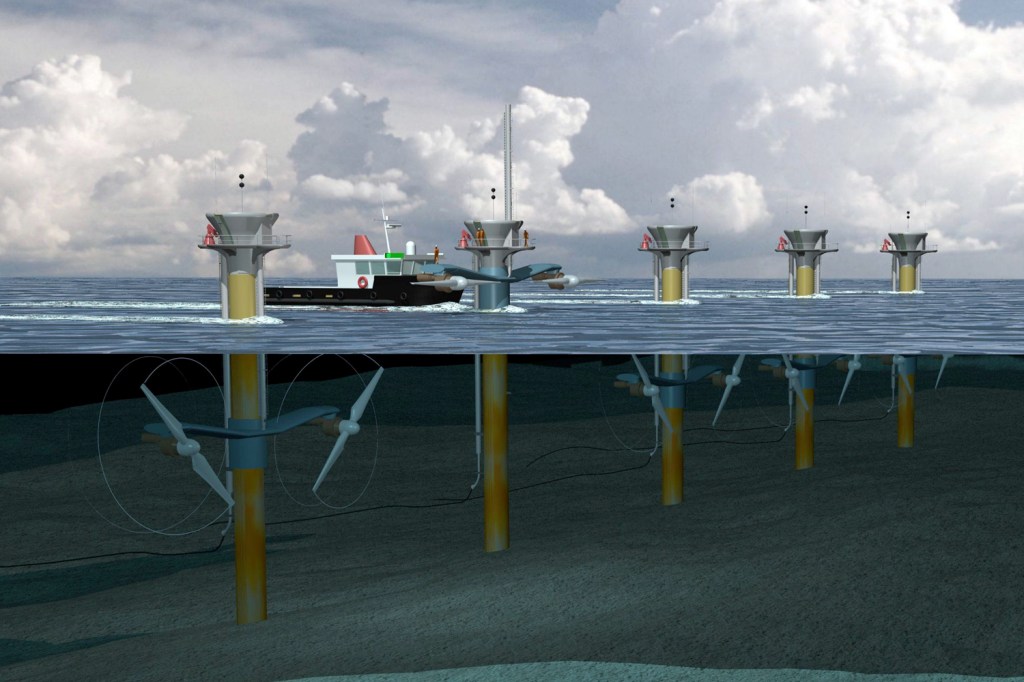
In the past, the potential of tidal energy was limited by its high cost and lack of sites with appropriate tidal ranges or velocity flows, thus limiting its full availability. The future of tidal energy is strongly influenced by its costs. It is currently a challenge for tidal power to compete with the prices offered by traditional electric companies using coal, oil and gas for their energy.
Recently, human reliance on electronic media and electricity has increased exponentially. This has forced the increase in electricity production to meet the demand that has existed. Various types of renewable energy have been explored to obtain a sustainable source of energy, however, tidal energy can be considered as one of the most important renewable energy sources.
To put it simply, it can be explained as the energy that is produced by the movement of tides back and forth. The energy from tidal flow originates from the interactions of centrifugal and gravitational force between the Earth, the Moon and the Sun.
Ocean energy is abundant, geographically diverse and renewable. It is a sector with a huge potential for growth which provides opportunities for Portugal to develop a new industry and create jobs. In practical terms, tidal energy is implemented in coastal areas, some of which have been affected by recent economic restructuring. In local terms, these areas that support development generate employment opportunities to associate, thus the economic benefits that the ocean can offer to coastal areas. In addition to this benefit, ocean energy can become the solution to fossil fuel imports, thus playing an important role in the transition (energy transition) to a low carbon economy to combat climate change and comply with the National Plan for Energy and Climate 2030 (PNEC 2030) and the Roadmap for Carbon Neutrality 2050 (RNC 2050).
References
Shetty, C., Priyam, A., 2021. A review on tidal energy technologies.
Ocean Energy Forum (2016). Ocean Energy Strategic Roadmap 2016, building ocean energy for Europe.
Hashemi, M., R., Neill, S., P., 2014. The role of tides in shelf-scale simulations of the wave energy resource.
Bahaj, A.S., 2011. Generating electricity from the oceans. Renew. Sustain. Energy Rev. 15, 3399–3416.


 Francisco Maia
Leave a comment