Recently, the recycling of municipal waste in Portugal has not kept pace with the rest of the European Union. Because of this, this article takes an in-depth look at the situation, with a current analysis of management, the challenges that exist and an analysis of ways to improve the country’s environmental performance. My aim is to captivate the reader with this issue, which is always undervalued, but has always been and will always be one of society’s greatest problems.
- Current situation
This article was based on data provided by the Annual Municipal Waste Report 2021, published in October 2022 by the Portuguese Environment Agency (APA), and the PORDATA platform.
To put it in perspective, in the timeframe covered by this report, the country and the world were recovering from the SARS-CoV-2 virus pandemic and were thus embarking on an era of normal economic activity. In addition, a new planning period was underway for the fulfilment of EU targets. This was the end of the era of the Strategic Plan for Municipal Solid Waste (PERSU 2020), which covered the years 2014 to 2020, with the country falling short of meeting the targets, and the beginning of the PERSU 2030 era.
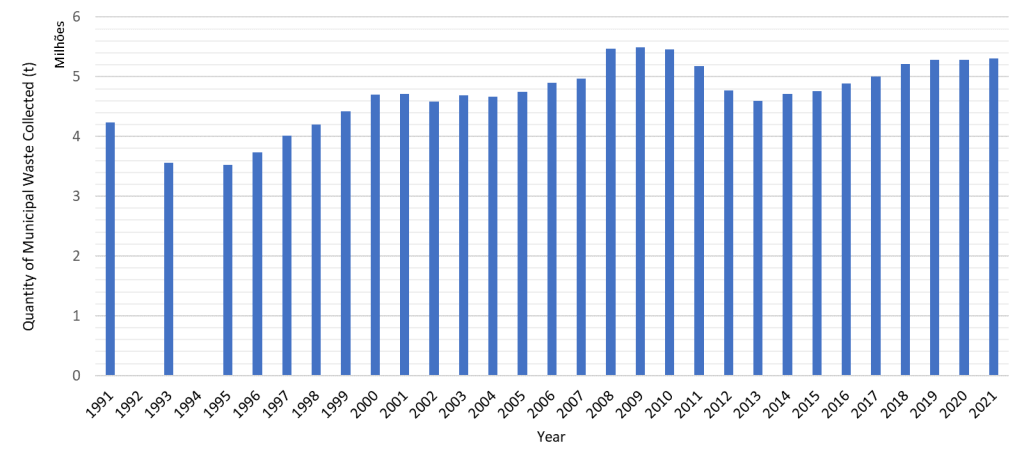
With regard to the total production of municipal waste (MW) in Portugal in 2021, there were no notable fluctuations in relation to previous years, particularly 2019 and 2020. Total municipal waste production was 5.31 million tonnes.
It’s worth noting that the figures for 2008 to 2010 were higher than the current ones. Then there was a decline in waste production, but the trend (from 2013) to the present day has been upwards.
According to the APA, in mainland Portugal, 31 per cent of waste was sent to landfill, 27 per cent to mechanical and biological treatment, 20 per cent to energy recovery, 13 per cent to material recovery, 6 per cent to mechanical treatment and 2 per cent to organic recovery (APA).
However, the reality is completely different if we consider the national territory. In 2020, waste going to landfill accounted for 53 per cent, and in 2021 this figure rose to 54 per cent.
In terms of other waste destinations, energy recovery represents the highest percentage after landfill, taking into account that there are only two facilities in mainland Portugal for this process, Lipor in Porto and VALORSUL in Lisbon. In the national context, in 2020 this process accounted for 19 per cent of waste. If two facilities are so representative, one can only imagine that if there were more facilities like these, the energy that could be harnessed from these resources would have gone to landfill.
On the other hand, in 2020, organic recovery accounted for 14% of the destination of waste, with a total of 24 facilities (19 for undifferentiated collection and 5 for selective collection).

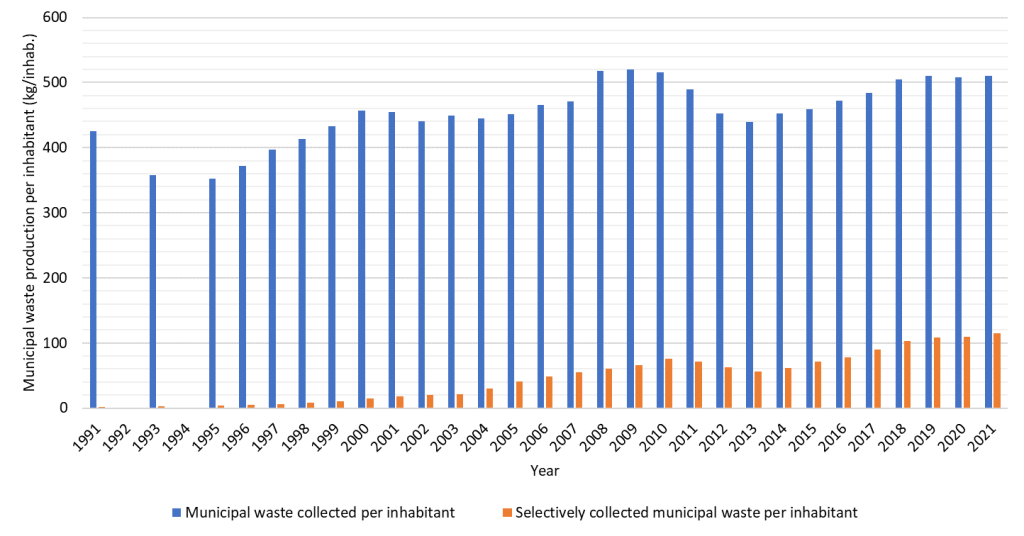
With regard to the amount of waste per inhabitant, there is an obvious tendency for waste to increase over time. This may be a consequence of the increase in the number of inhabitants in Portugal, or it may be due to other external factors. However, the unquestionable fact is the difference in undifferentiated and selective collection. Selective collection is increasing over time, but in order to improve the recycling of municipal waste in Portugal, selectively collected municipal waste needs to increase much more for this to become a reality. Because recycling comes from the selective collection of municipal waste.
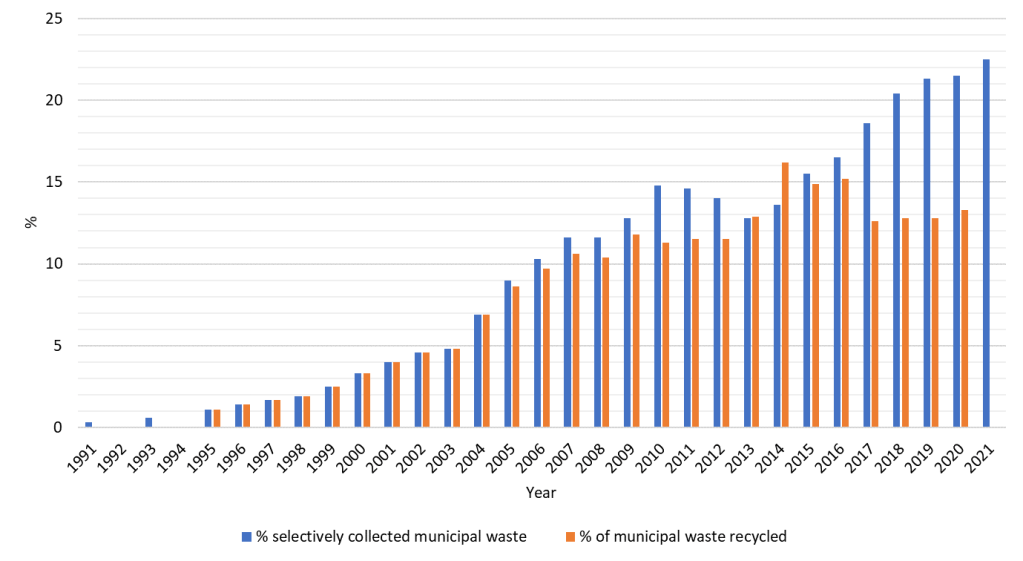
In the first decade of records, the amount of municipal waste collected selectively and the amount that ended up being recycled were identical. However, from 2005 onwards, the figures began to widen, with the amount of waste recycled even exceeding the amount of waste collected selectively, which may indicate an anomaly in the data collection that year, as you can’t recycle waste that doesn’t exist. Since 2017, the gap has been widening, demonstrating the difficulty of recycling in Portugal.
2. Waste Management Challenges in Portugal
Waste management in Portugal faces a number of significant challenges that require ongoing attention and action. Although notable progress has been made in implementing more sustainable practices, there are still obstacles to overcome to ensure effective and responsible waste management in the country. From improving selective collection to the proper treatment of hazardous waste and the transition to a circular economy, the challenges are diverse and require a holistic approach. In addition, public awareness and education play a crucial role in promoting changes in behaviour and the active involvement of all sectors of society. In this context, it is essential to understand the main challenges facing waste management in Portugal in order to direct efforts towards finding sustainable solutions and promoting a cleaner and more resilient future.
- Selective collection: Despite efforts to improve selective collection, there are still difficulties in ensuring the proper separation of waste at the generating sources, such as households, companies and institutions. Lack of environmental awareness and adequate infrastructure are obstacles to the effective implementation of selective collection.
- Landfill sites: Portugal relies heavily on the disposal of waste in landfill sites. However, the capacity of these landfills is running out, which creates the need for new waste management solutions. In addition, the operation of landfill sites can result in significant environmental impacts, such as the contamination of soil and water resources.
- Treatment of hazardous waste: The proper treatment of hazardous waste, such as chemicals, industrial waste and expired medicines, is a significant challenge. The proper management of such waste requires specialised technologies and appropriate facilities, which are not always adequately available throughout the country.
- Circular economy: Promoting the transition to a circular economy is a challenge in waste management in Portugal. This involves reducing resource consumption, reusing products and recycling waste to minimise waste generation and promote sustainability. The effective implementation of circular economy practices requires changes in behaviour and an integrated approach throughout the value chain.
- Awareness-raising and education: Raising awareness and educating the population about the importance of proper waste management are key to achieving better results. It is necessary to promote a change in mentality, encouraging reduction, reuse and recycling, and to inform about correct waste management practices. This involves awareness-raising campaigns, education in schools and community engagement.
- Cooperation and coordination: Waste management involves different actors, such as local governments, companies, civil society organisations and citizens. It is essential to promote co-operation and co-ordination between these actors in order to establish effective policies and strategies, share resources and knowledge, and ensure the proper implementation of waste management measures.
3. Good Practices and Sustainable Initiatives
The implementation of good practices and effective initiatives plays a crucial role in improving waste management performance in Portugal. With a proactive and innovative approach, it is possible to tackle existing challenges and promote a more sustainable and efficient system. From strengthening selective collection to promoting the circular economy and continuing education, these practices have the potential to create positive impacts across the country. By adopting integrated and collaborative strategies, and investing in advanced treatment technologies, Portugal can take significant steps towards more responsible waste management in line with sustainability principles. From this perspective, it is essential to explore and implement initiatives that encourage reduction, recycling, reuse and awareness, mobilising both the active participation of the population and the commitment of the public and private sectors.
- Reinforcing selective collection: investing in adequate infrastructure and awareness campaigns to promote the correct separation of waste at the generating sources, encouraging the active participation of the population and companies.
- Encourage reduction and reuse: promote the reduction of resource consumption and the use of reusable packaging and products, encouraging practices such as buying in bulk, the use of reusable bags and the adoption of refillable packaging.
- Investing in recycling: expanding recycling systems and facilitating access to selective collection points, including the installation of more containers for different types of recyclable materials, such as plastic, paper, glass and metal.
- Encouraging composting: encouraging home and community composting, offering guidance and resources so that citizens can turn organic waste into fertiliser, reducing the amount of waste sent to landfills.
- Promote the circular economy: Promote policies and programmes that encourage the implementation of circular economy practices, such as promoting the repair of products, the recovery of materials and the reintegration of waste into the production chain as a raw material.
- Strengthen cooperation and coordination: Promote collaboration between local governments, companies, civil society organisations and communities to develop joint strategies, share knowledge and resources, and implement effective waste management measures.
- Continuous education and awareness-raising: Invest in educational programmes in schools, public awareness campaigns and community events to raise awareness about the importance of proper waste management and promote changes in behaviour.
4.Conclusion
To summarise, an increase in waste production has been observed over time, while the recycling rate and selective separation still face significant challenges. The dependence on landfill sites as the final destination for waste and the lack of adequate treatment for hazardous waste are other important issues that require attention.
I intend to draw attention to the urgent need for a change in attitude towards waste management. Raising awareness and educating the population are key to promoting the correct separation of waste, reducing resource consumption and adopting more sustainable practices. It is essential that each individual becomes an active agent in the reduction, reuse and recycling of waste (RRR), contributing to the protection of the environment and the preservation of natural resources.
In this way, I also emphasise the importance of a sustainable approach for the country’s future. The transition to a circular economy, where waste is seen as a resource and reintegrated into the production chain, is fundamental to minimising waste generation and promoting sustainability. The implementation of good practices and effective initiatives, such as strengthening selective collection, encouraging reduction and reuse, investing in recycling and promoting composting, can lead to significant progress in this direction.
In short, urban waste management in Portugal faces major challenges, but it is essential to recognise that change is possible and necessary. It’s time for all sectors of society to come together and adopt a sustainable approach to ensure a cleaner and more resilient future. Proper waste management is not just the responsibility of the relevant authorities, but of each and every one of us as citizens who are aware of the impact our actions have on the environment. Together, we can make a difference and build a more sustainable country for future generations.
Bibliography
PERSU 2030. Plano Estratégico para os Resíduos Urbanos 2030. Agência Portuguesa do Ambiente.
PERSU 2020. Plano Estratégico para os Resíduos Urbanos 2020. Agência Portuguesa do Ambiente.
Fundação Francisco Manuel dos Santos, 2023. PORTALDATA: Estatísticas sobre Portal e Europa.
RARU 2021. Relatório Anual Resíduos Urbanos 2021. Agência Portuguesa do Ambiente.


 Francisco Maia
Leave a comment