
I see a good intention in electric vehicles, but they are already being directed by variables controlled by third parties to places where, in reality, they are difficult to applaud. It sounds a bit poetic, so I’ll explain in more detail.
The concept of the electric vehicle currently makes sense in small applications, i.e. in city vehicles such as the Renault Zoe and Nissan Leaf. Medium-sized applications can still make an appealing case, such as the Tesla Model 3 and the Mercedez Benz EQE. The same can’t be said for large vehicles like the Tesla Model X and especially lorries. The technology simply isn’t there yet to realise these applications. The energy required to build batteries, assemble the vehicles and even use them has a greater impact on the environment than the benefits.
Today, electric technology is not capable of sustaining the world economy in the way that fossil fuels can. It’s impossible to build lorries to carry the loads and travel the necessary distances, and it’s impossible to build ships to cross oceans and transport the loads to supply countries. Fossil fuels won’t disappear, because we’ll be relying on them for much longer.
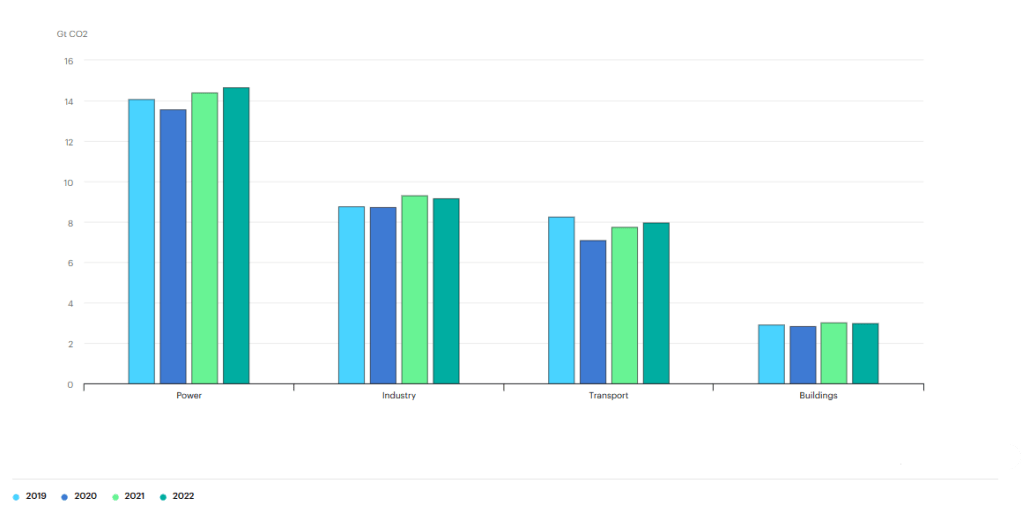
Now let’s look at Figure 2, which illustrates the total emissions of the four most polluting sectors between 2019 and 2022. Placing so much emphasis on a single sector and imposing taxes on people due to CO2 emissions from vehicles, sometimes beyond their control due to lack of access to greener alternatives, is, in my opinion, inhumane (case in Portugal). Furthermore, as reflected in Figure 2, at a global level, transport is the third largest contributor to pollution, while other sectors need equal or greater attention and dedication.
I don’t want to take credit for electric vehicle technology, on the contrary, I want it to be more widely adopted. However, I’m not a fan of the way they’re handling the situation. A technology has to be adopted on its own merits, it has to demonstrate its value for people to make the decision to adopt it. It’s not by forcing or even stifling people to change that they will be adopted, this will only worsen the population’s perception of this technology.
That’s why I wonder if there’s something behind all this.
In my dissertation I emphasised the life cycle of electric vehicles and internal combustion vehicles through a literature review. I decided to do this simply because it was of interest to me, as it didn’t fit in with the objectives of the dissertation. Perhaps I’ll devote a blog article just to this review. What I’ve discovered has comforted a suspicion of mine.
When making this comparison, it’s very easy to emphasise the carbon footprint related to fossil fuels, because it’s true and it’s an easy target. It’s extremely polluting. However, if the problem is with fossil fuels, then you take them out of the equation, and do the same with electric vehicles. That’s my answer.
What I discovered was interesting, and reveals a very heavy truth. Comparing the life cycle of the electric vehicle with the life cycle of the internal combustion vehicle, stage by stage, electric vehicles are inferior to internal combustion vehicles in the intermediate stage, the stage of utilisation of the vehicle. This is due to the fact that internal combustion vehicles require more materials at this stage, i.e. maintenance. Because in both the production and end-of-life stages, raw materials, energy and even fossil fuels exceed the quantities used in internal combustion vehicles.
So instead of opening mines and destroying entire landscapes, why not pursue the path of sustainable fuels as they are proposing in aviation and maritime? That’s my question.
My solution is synthetic fuels. Synthetic fuels are fuel products made from non-oil raw materials, such as natural gas, coal, biomass. However, if you’re aiming for a sustainable fuel, it doesn’t make sense to use a fossil fuel to produce it. I’m referring to the method of producing these fuels using CO2 captured from the atmosphere. This means that the CO2 that comes out of the exhaust is the same CO2 that was taken out of the atmosphere to make it, so it’s called a sustainable fuel.
Electric vehicles are an extraordinary human innovation, but they are extremely complicated. Until today, since the invention of the motor car, it was somewhat easy to work on a car, as everything was mechanical. A normal person, if they wanted to, could do the servicing, certain faults could be repaired by the owner, and in a way, the owner was in control of their own car. Only for complex faults did you have to call in mechanics. Now, with the complexity that cars have adopted, through various electrical systems, and the case of electric vehicles, a person no longer has that freedom, they have to turn to the brand to repair them. Not to mention the fact that today’s vehicles can be controlled remotely by third parties.
Synthetic fuels would prevent this. They would improve the sustainability of the transport sector and ensure that internal combustion vehicles remain in use, and help the many people who depend on them in their lives.
To finish off, and to leave you milling about, let me ask you a question. If climate change is a global problem and everyone’s problem, why suffocate people financially? Or is it an excuse to tax and profit from it?
References
IEA, 2023. Global CO2 emissions by sector, 2019-2022. IEA; Available at: https://www.iea.org/data-and-statistics/charts/global-co2-emissions-by-sector-2019-2022; Last access to: 1st November 2023.
European Council, 2023. Fit for 55. European Council; Policies; European Green Deal; Fit for 55; Available at: https://www.consilium.europa.eu/en/policies/green-deal/fit-for-55-the-eu-plan-for-a-green-transition/; Last accessed on: 1 November 2030.


 Francisco Maia
Leave a comment