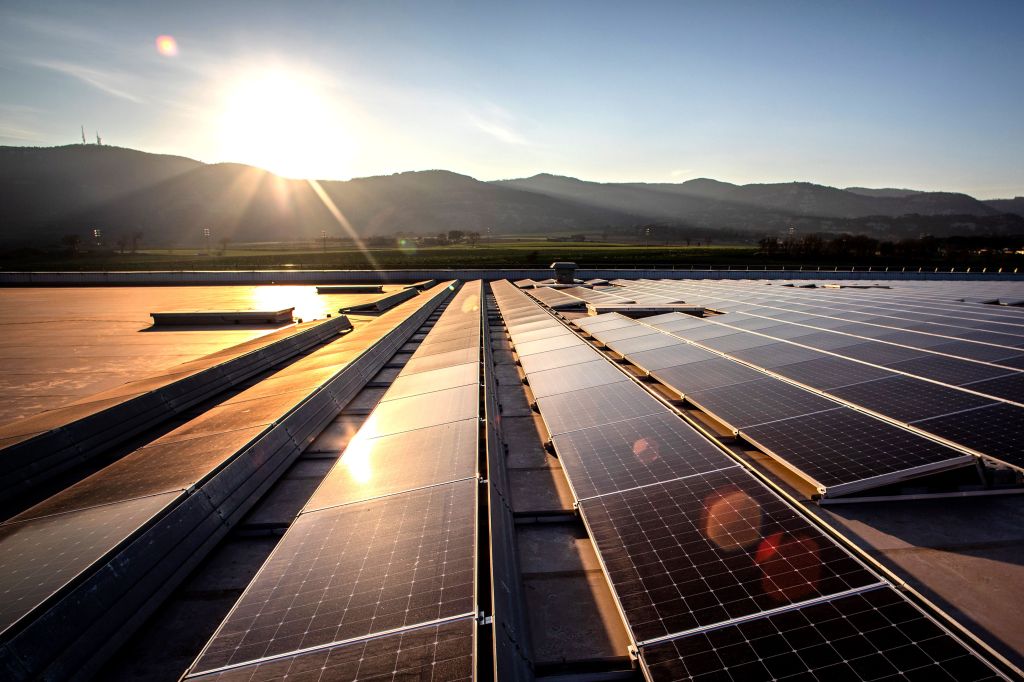
The efficiency of a photovoltaic panel is nothing more than the solar energy (irradiance) that reaches the panel and is transformed into electrical energy, which currently, depending on the panel, is around 18% to 20%.
I’m of the opinion that we should always aim for the best possible, in this case the best possible efficiency. However, let’s put it cleanly through reasons that people can relate to in their daily lives. In a residential environment, people have limited space on their roofs to place photovoltaic panels, plus the fact that people’s daily lives are becoming increasingly electrified, from electric cookers to electric vehicles, the need for a power-to-space ratio is becoming increasingly important.
There are various types of photovoltaic panels, but that’s a topic for another article.
Here we’ll take a closer look at the materials used in today’s panels. The most prevalent on the market are monocrystalline and polycrystalline. Polycrystalline panels are becoming less and less common on the market. These two are made from Crystalline Silicon, a material that is very stable as a semiconductor. However, it is not the only semiconductor material that can be used in photovoltaic panels, there are others.
To put it into context, the photovoltaic effect, simplifying the concept and as described by Koncar and Nocito (2016), involves the generation of a potential difference in a semiconductor slice when exposed to sunlight. The radiation creates electron gap pairs, increasing the concentration of minority carriers. These carriers generate photogenerated current, balanced by recombination current when the junction is open-circuited. This process converts photonic energy into direct current electricity.

This condition can exist in other materials, not just crystalline silicon. Other materials include Thin-Film containing amorphous silicon, cadmium telluride, copper-indium-gallium-selenium.
One of the most promising materials that is becoming popular in the research field, and which I have already devoted an article to, is the Perovskite material. This material is characterised by its flexible texture and offers the opportunity to use lower quantities of material than are currently used in the production of crystalline silicon. Perovskite doesn’t necessarily offer superior energy conversion to the panels on the market, but it does offer the potential to be much cheaper and more flexible in terms of implementation. This is because the idea is to use this material on smooth surfaces, such as glass and walls.
The National Renewable Energy Laboratory (NREL) maintains a graph of the highest confirmed conversion efficiencies for research cells in a range of photovoltaic technologies. Figure 1 is a version of this chart taken from the NREL website’s Interactive Best Research-Cell Efficiency Chart” on 9 December 2023.

This graph is about the historical laboratory results of the most efficient cells in the years that the respective tests took place. I’m emphasising this because laboratory results are one thing, but the efficiencies of photovoltaic panels when you build the system for the customer are quite another. Because to get results similar to these in practice, in people’s homes, means that the panel material and the panel itself are financially viable to put on the market and the brand that is going to introduce it to the market has already built the factories to manufacture them. In short, it takes years to go from laboratory testing to implementation in commercial applications.
So the important thing to take away from this is the fact that as far as efficiency is concerned, in the near future, the next 10 years, there won’t be any major gains in this area of photovoltaic panels. What we can see is the increase in panel area. By increasing the area of the panel, more solar radiation is captured, and consequently more solar energy is transformed into electrical energy, thus increasing efficiency. To illustrate this point, the Huasun solar panel brand recently reported that the G12 range of panels achieves a power output of 750,544W, with an efficiency of 24.16% (Huasun, 2023).
If you’re thinking of installing photovoltaic panels on your house and you’re worried that the technology will overtake the ones you’re planning to install, I’m telling you, don’t be afraid. The evolution of technology is stagnating, like smartphones today. In the early years, they evolved tremendously, with bigger screens, better cameras and faster processors. Today, however, the year-on-year improvements aren’t noticeable to the average person. A Samsung Galaxy S20 is barely behind an S23, the difference isn’t worth the price and you can’t tell. What difference does a mobile phone being 0.01 seconds faster make to a person’s life, in my opinion it doesn’t make much difference. As for a panel being a thousandth of a percentage more efficient in five years’ time, it won’t be worth waiting for, as you’ll be losing out on the potential benefits of a photovoltaic system in terms of energy bill savings because of a factor that you’ll barely notice.


 Francisco Maia
Leave a comment